Please Note: Once again this is a particularly long post, so subscribers will find the emailed version of this issue cut off at the end. Please go to the web version for the complete version.
If You Find AgenticMSP Valuable: Please recommend AgenticMSP to your friends and colleagues. Also, please offer up your comments, observations, questions, or any other responses in the chat below. Let’s get a hearty conversation going!Their messaging has just not been the best. Most of the people who are working at the frontier model-makers are engineers and developers. Only Anthropic has launched a channel partner program and none of them has distinguished themselves with awesome advertising.
Remember CDs (Compact Disks)? Or even further back, do you remember vinyl record albums that you put on a turntable and lowered a needle onto?
What good would a CD be if you didn’t have a CD player? And what good are old vinyl records to anyone who doesn’t have a phonograph (fancy for “record player”)?
None whatsoever.
The same is true of any large language model (LLM) that doesn’t have a harness.
What the Heck is an AI Harness?
You probably run into the word “harness” more and more when reading about AI because everyone is coming to realize just how important it is to have a good one, the right one.
What is it?
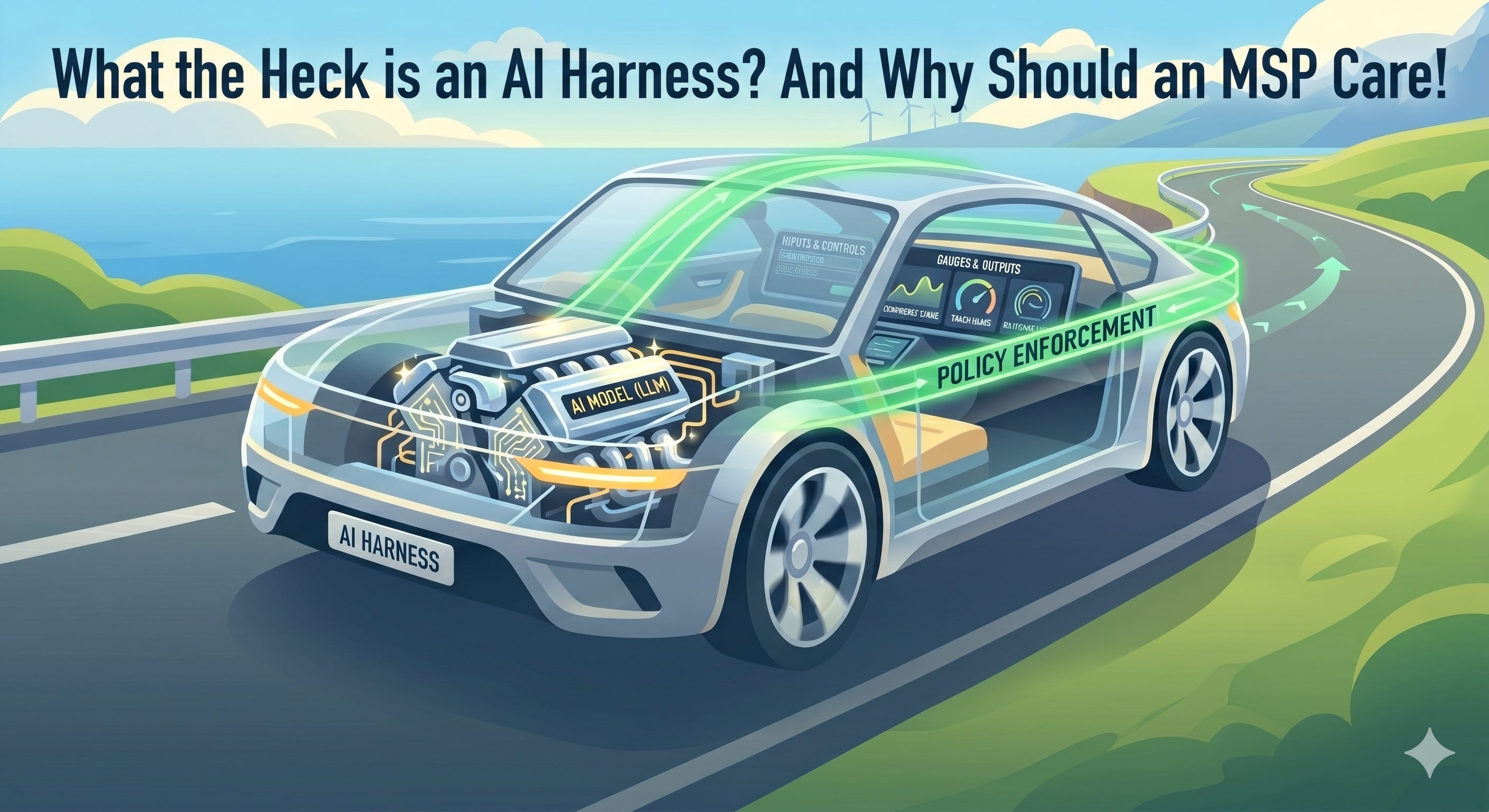
An AI harness is the scaffolding that surrounds and controls an AI model. Everything except the model itself. Consider the LLM to be the engine in your car. The car itself would be the harness, because it enables the engine to actually do something useful. It provides all the controls, the gauges, and more recently it even contains guardrails that keep you and your engine from veering off the road.
Here’s what a harness typically includes:
The prompt layer — how instructions and context get assembled and sent to the model
Tool connections — what the model can call (web search, APIs, databases, other models)
Memory and context management — what the model knows about the conversation or task history
Output handling — what happens with the model’s response (is it displayed? parsed? fed into another process?)
Guardrails and evaluation — checks that catch errors, hallucinations, or out-of-bounds behavior before they cause damage
Harness engineering then, is the discipline of designing and building that scaffolding. It’s distinct from AI research which improves the models themselves and from traditional software engineering which doesn’t deal with the probabilistic, often-unpredictable nature of LLM outputs. Harness engineers think about questions like:
· “How do I chain multiple model calls together reliably?”
· “How do I give the model just enough context without overloading it?”
· “What happens when the model produces something unexpected?”
· “How do I catch that before it breaks downstream systems?”
In the agentic world, this is where most of the real-world complexity lives. The models are increasingly commoditized. The harness, how you wire the model into a real business workflow, with real tools and real failure modes, is where the differentiation happens. It’s engineering judgment applied to inherently imperfect AI outputs.
To put it simply: the harness is everything you build around the model to make it actually work in the real world.
Why is the Harness so Important to MSPs?
Most simply because the model is largely out of your hands, and the harness isn’t.
The major LLMs, ChatGPT, Claude, Gemini, and the like are converging in capability. They’re all actually hopping over each other and catching up, which is narrowing the gaps between them and making the selection almost moot. Besides, for most business use cases any of the “frontier” models will do the job nicely. Even some below the frontier…
The harness, on the other hand, is entirely yours to design and own. We’ll talk momentarily about how you get started doing that. The harness determines almost everything that actually matters in any production deployment, including:
· Reliability. Models are probabilistic, just like Ethernet. They hallucinate, drift, misinterpret ambiguous instructions. The harness is what catches those failures before they corrupt a workflow or reach a customer, just like CSMA/CD (Carrier Sense Multiple Access with Collision Detection). For those of you who don’t focus on networking, ask someone who does!
· Integration. If anyone appreciates the importance of integration, it’s you! A model sitting alone does nothing useful. The harness connects it to your data, your tools, your APIs, your business logic. That connection work is hard, custom, and not something any model vendor does for you.
· Control. In agentic systems especially, a model can take actions like send emails, query databases, execute code, and call other agents. The harness governs what it’s allowed to do, in what sequence, with what human checkpoints. Without that, you don’t have an AI system. You have a loaded weapon with no safety.
· Reproducibility. Getting a model to do something impressive once in a demo is easy. Getting it to do it correctly, consistently, at scale, across edge cases requires a well-constructed harness.
· Competitive advantage. If your competitor uses the same LLM you do but has a better harness providing better context management, better tool orchestration, and better error handling, they win. The model is the commodity. The harness is the moat.
The analogy that keeps surfacing in engineering circles: electricity is the commodity, the appliance is the product. Nobody competes on access to electricity. They compete on what they build with it.
For MSPs specifically this reframes the whole conversation. The question isn’t “which AI should we use?” It’s “how do we build the harness that makes AI actually work inside our clients’ environments?” That’s where the service opportunity lives.
How Do We Start Creating That Harness Opportunity?
The answer is actually much more accessible than most MSPs may assume.
Start with a real problem, not a technology.
The worst place to begin is “we want to build an AI solution.” Given that we believe in beginning with the end in mind, the best place is “we have a specific workflow that’s costing us time, money, or errors and we want to fix it.” Start with a customer’s problem, as you always have throughout your tech career.
The harness has to be built around something concrete. Ticket triage, onboarding checklists, security alert summarization, client reporting, those are all good examples you can relate to personally. Pick one thing that’s particularly painful and bounded.
Understand what a harness actually requires in practice.
For an MSP, building a harness means answering these five questions:
What does the model need to know to do this job? (context and data sources)
What tools does it need to call? (PSA, RMM, ticketing system, documentation)
What sequence of steps does it follow? (the workflow logic)
What can go wrong, and how do we catch it? (error handling and human review points)
How do we know it’s working? (evaluation and monitoring)
The actual, practical, build path:
Most MSPs will not write harness code from scratch, nor should they. The realistic starting points are:
Low-code/no-code orchestration platforms like n8n, Make, Frontier, or other, which let you wire AI calls into workflows without deep engineering. These are genuine harnesses. They handle sequencing, tool connections, and conditional logic.
Purpose-built MSP AI platforms like Gradient MSP, Rewst, or SuperOps that are beginning to embed agentic capabilities with MSP-specific integrations already built in. Working with these, the harness scaffolding is partially pre-built for you.
Frameworks like LangChain for MSPs that have a developer on staff or a development partner. These give you programmatic control over every harness component.
Which is Most Likely to be the Best Place to Start?
Each MSPs circumstances are different, but most pick Rewst or n8n. Find one internal workflow, not a client-facing one yet. Build a simple automation that calls an LLM at one step to do something the model is genuinely good at like summarizing, classifying, or drafting. Get that working reliably. Then expand.
The discipline you’re building isn’t AI expertise. It’s workflow engineering with AI as one of the components. If you’re like most MSPs, you already think in workflows. That’s actually a significant advantage over, say, a generic software developer who has never had to make a promise about uptime to a client. Right?
What to avoid early:
Don’t start with an agentic system where the AI takes autonomous action. Start with AI-assisted workflows where a human still approves the output. Build trust in the harness before you remove the human from the loop. That sequencing matters enormously both for reliability and for building client confidence.
The MSPs who own this space won’t be the ones who understand AI the best. They’re the ones who get good at “harness thinking” first.
Human’s Steer. Agents Execute.
From the AI Realized Now Substack: “Prompt engineering gets you a better single response. Harness engineering which brings the tools, validation hooks, review playbooks, and output pipelines surrounding the agent, gets you a better system.”
Here are three core qualities of harness engineering:
1. The model itself doesn’t change. The improvements come from the agent’s harness: its tools, prompts, review playbooks, and output pipelines. That means enterprises don’t need to retrain or fine-tune anything.
2. The learning is auditable. Each improvement is a discrete, inspectable change (a new cross-document review playbook, a validation hook, a file-conversion pipeline), not an opaque weight update.
3. The quality bar is set by humans. The rubric is what drives the agent’s improvement cycle.
As Niko Grupen, Head of Applied Research at Harvey, the legal AI platform used by major law firms and in-house teams worldwide, puts it: “Humans steer. Agents execute.”