


Please Note: Once again this is a particularly long post, so subscribers will find the emailed version of this issue cut off at the end. Please go to the web version for the complete version.
If You Find AgenticMSP Valuable: Please recommend AgenticMSP to your friends and colleagues. Also, please offer up your comments, observations, questions, or any other responses in the chat below. Let’s get a hearty conversation going!
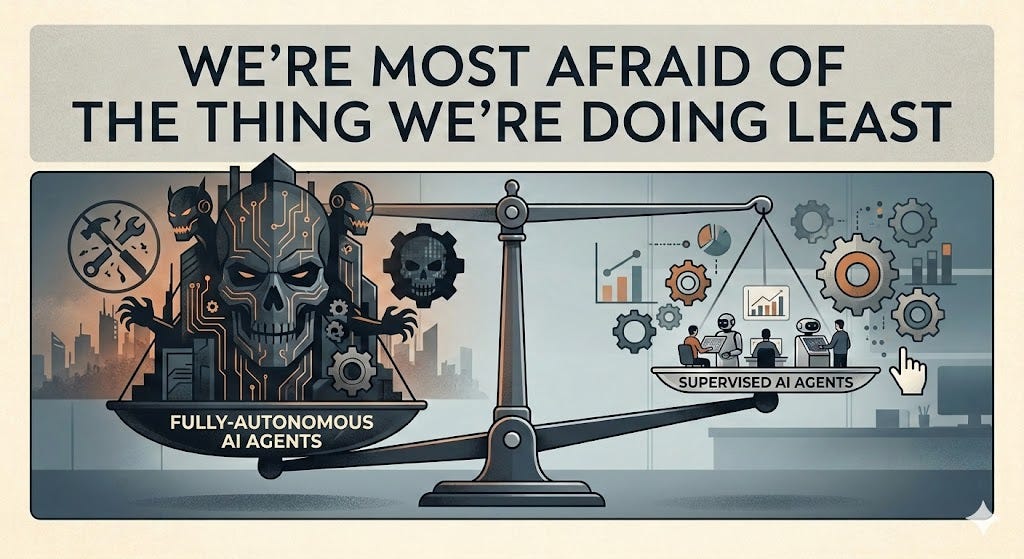
If you’re wondering how many of the AI agents that are in use today are “fully autonomous,” the short answer is very few. A fuller answer depends on how you define “fully autonomous,” and that problem with the definition is a big part of the underlying story..
The most authoritative number comes from Gartner. In a mid-2025 survey of 360 IT application leaders, only 15% said they were even considering, piloting, or deploying fully autonomous AI agents which, just to be clear, is defined as goal-driven tools that require no human oversight. That’s the ceiling, not the floor. The actual deployment figure is lower.
A separate data point from MindStudio, citing January 2026 data: while 88% of companies now apply AI in at least one area, only 23% run fully autonomous agent systems. That’s a broader definition of “fully autonomous” than Gartner’s, which likely explains the higher number.
Why So Few Fully-Autonomous Agents?
For one thing, many people are scared out of their minds of fully-autonomous AI agents. Why?
· They’re going to take everyone’s jobs
· They’re going to take over the world
· They’re going to wipe out the human race
· Here Comes Judgement Day, when Skynet Becomes Aware!!!
It might almost be laughable if so many people weren’t genuinely scared. I wrote an article years ago that quoted three people saying AI was insanely dangerous: Bill Gates, Stephen Hawking, and Elon Musk (in reducing order of importance and relative sanity.)
Some Reasons Are Not So Funny
We recently discussed how the days of venture capital subsidizing everyone’s use of AI was coming to an end. Much more attention is being paid to the rate of token consumption. Many of the most current articles are being written about how different LLMs seem to generate different results, but it’s altogether possible the difference is not in the model as much as it is in the user’s economical prompting strategies.
