Please Note: Once again this is a particularly long post, so subscribers will find the emailed version of this issue cut off at the end. Please go to the web version for the complete version.
If You Find AgenticMSP Valuable: Please recommend AgenticMSP to your friends and colleagues. Also, please offer up your comments, observations, questions, or any other responses in the chat below. Let’s get a hearty conversation going!Their messaging has just not been the best. Most of the people who are working at the frontier model-makers are engineers and developers. Only Anthropic has launched a channel partner program and none of them has distinguished themselves with awesome advertising.
But even closer to the ground, these model-makers have done a pretty miserable job of building consistent messaging that normal customers can understand and find relevant. In fact, they continue to confuse people with varying descriptions of things, and a dizzying flow of new announcements that are keeping most of their buying audience very confused.
I Smell Opportunity
The AI frontier makers are not the first to suffer from miserable messaging. There have been many times that channel partners have shaken their heads and asked Microsoft why they were promoting things the way they were. And Apple, though their messaging is always delivered with beautiful imagery.
Remember what customers want most; to talk with someone who knows what they’re talking about when talking about tech. They hesitate to make investments until they’ve achieved clarity as to what they’re investing in.
If you, as their MSP can come in and clear up their mystery, their confidence and trust in you will grow. That creates opportunity! You’ve been looking for ways to start selling AI solutions into your customer base. Here’s a great opportunity to start up a productive conversation that answers their questions, clears up their confusion, and opens the door to exploring what you can do for them with AI solutions.
Mediocre Messaging Makes Misinformation and Mystery
Copilot is a vivid example of this messed-up messaging. Satya Nadella strutted across the stage for the past two years extolling the fantastic promise of AI that is embodied in Copilot.
“What the heck is Copilot?” was and continues to be a very popular question. Microsoft never really gave us a clear understanding of it. Microsoft employees all rave about it and how much more productive it has made them. This continues the sleight-of-hand Microsoft has mastered. Lets dispel some of the mystery and misinformation that masks Copilot’s true nature.
There’s No Microsoft LLM
I must admit that it was months after I first heard about Copilot that I came to understand that it wasn’t a large language model. Nope. It’s not the same as ChatGPT, Gemini, Claude, DeepSeek, even Grok or the recently introduced Nemotron.
So, if it isn’t an LLM itself, what does it do to access the magic of AI?
Underneath Copilot lurks ChatGPT. Microsoft and OpenAI entered into a licensing relationship allowing Microsoft to hook up Copilot to ChatGPT. Yes, when you’re using Copilot you’re using ChatGPT.
Now that doesn’t hold true for ALL the Copilots. For example, Microsoft replaced ChatGPT with Anthropic’s Claude to support Copilot for Microsoft 365. This came just after Anthropic demonstrated how well Claude works with Excel and PowerPoint. So, when you’re using Copilot for Microsoft 365 you’re actually using Claude. This becomes even more intriguing when you check out Claude for Excel and Claude for Powerpoint, both recently introduced by Anthropic and both integrated into those applications. That’s right. You just run Excel and you have Claude for Excel right there to help you.
A few months ago I reported on an interview that Dwarkesh Patel conducted with Satya Nadella during which the Microsoft CEO described a 7-year plan that would ultimately result in a Microsoft LLM.
Seven years?
In this issue of AgenticMSP you’ll read about how Microsoft has changed its agreement and its relationship with OpenAI and are now introducing a series of products that demonstrate how their progress toward their own LLM has accelerated.
When I asked Anthropic what the difference was between Claude and Copilot for Microsoft 365 they weakly muttered something about how the Microsoft implementation was tuned to be more focused on the Microsoft product suite.
Bottom line: As far as I can tell, Copilot is a harness for whatever LLM Microsoft selects as the back end. Every LLM has a harness that is the software that allows people to use the LLM. It ends up being your interface with it. And it can be focused very specifically. The harness you see in the chatbot is far more generic.
Here’s a Good “First AI Thing to Sell”
The most popular question I get from the MSPs I speak with about AI is “I don’t know where to start, so what can I sell first?”
Many of you will remember that Microsoft first introduced the concept of “co-selling”. When I was a fledgling computer salesguy we called that going on a “buddy call” or “selling together” of “vendor support of the channel”. It only became a real thing when Microsoft gave it a name. Exhausting.
I was recently speaking with a Microsoft executive who was regaling me with how much productivity he was getting out of Copilot Cowork! Another example of Microsoft’s AI superiority!
Not.
What Microsoft AI superiority?
This time, someone beat them to the “Co”. That someone was Boris Cherny at Anthropic who was the chief developer of Claude Code, the agent building environment everyone is raving about.
Once Claude Code was out there, Boris had an inspiration to create a general-purpose agent using Claude Code.
And that’s how Claude Cowork was born.
And that’s how Microsoft came to license it. Yup. Copilot Cowork is Claude Cowork in disguise.
Cowork is an excellent “first thing to sell” for MSPs, mainly because it’s so informal, so fundamental, and so incredibly useful.
How we Work with Cowork
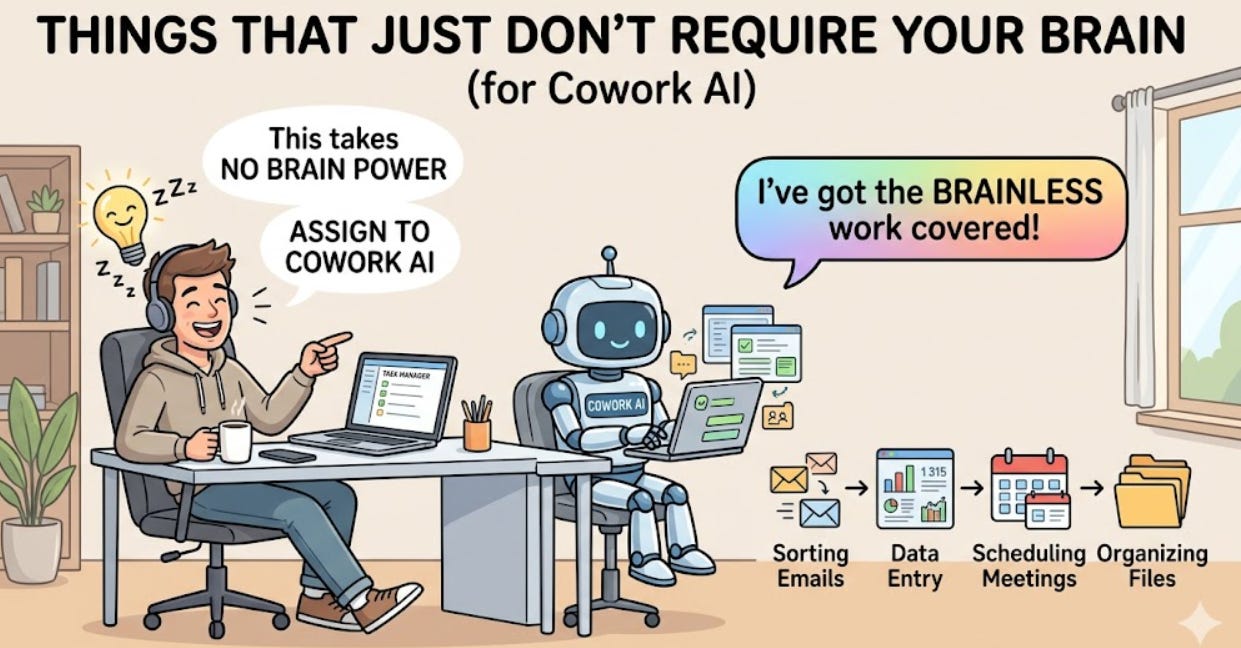
Have you ever found yourself in the middle of a workday and you realize that what’s nagging you is something you need to do that is insanely boring, insanely mechanical, tedious, and takes a long time to do? We all have.
I’m referring to such things as “things that just don’t require a human brain.”
When you identify one of these… give it to Cowork. The good news is that all you need to do is to tell Cowork to do it. Many people think that means spelling out the task step-by-step and they invest way too much time giving instructions they don’t need to give. Cowork is remarkably good at figuring out how to do what it’s asked to do. It examines the resources and figures out how to use them. If it can’t figure something out it will ask.
I now find myself with Cowork (the Claude original) right next to me on a screen. When I find myself grumbling about what I need to do next I suddenly perk up and tell Cowork to do it. I then go on to other things I need to get done. Cowork has helped organize my contacts, streamline my Todoist task management, distribute a folderful of files each out to the folder it really belongs in.
For your first AI sale to your existing customer base offer to teach them how to get started getting hours of their time back by assigning anything that just doesn’t require their brain to Cowork!
They will thank you by coming back to you for more and more AI solutions.
Start by asking Cowork to produce some impactful information sheets for you to send to your customers to get your offering started!